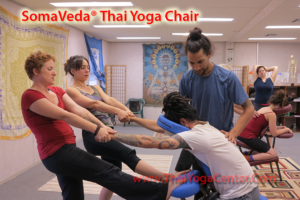
Yoga Massage and Thai Massage Chair Technique on a portable massage chair is the perfect adjunct to your existing practice for so many reasons. Having a portable massage chair opens up the possibility for mobility and the expansion of your practice. First of all, virtually any kind of portable massage chair is suitable. I know there are a good variety of makes and models in different price ranges. I’ve seen them on Craig’s list for as little as $50.00, EBay for $100.00 (new) and up to $500 or $600 retail in some massage magazines. To start with, I recommend a basic, sturdy chair in your lower price range. If you like the work (as I think you will!) then bump it up with some bells and whistles to enhance your sessions like a fully adjustable face cradle, etc. I simply set up the chair and adjust in such a way that I do not have to mess with any settings once I get moving. After all, the whole point of any tool (and a portable massage chair is a tool) is to assist me. I don’t work around the chair, I use the chair!
The chair techniques we use in the Thai Yoga Massage Chair Vinyasa or flows are basically adaptations of the standard seated position flows we already practice. For example, there is a traditional seated flow in every style of Thai Yoga (Traditional Thai Massage). Some are very simple like the Seated Position flow in our SomaVeda® Fundamentals of Thai Yoga: Level One. Some seated position flows are more exhaustive such as in our Ayurveda Thai Yoga: Level Two, our Nuad Boran, Northern Style Flow in SomaVeda® Level Three and the more advanced courseswhich we teach in our Certified Thai Yoga Practitioner Program (CTP). The traditional style flows in the seated position on the mat are optimal for perfect body mechanics and have been refined for centuries in various schools. The techniques themselves are not new. The chair application is new and has been in practice for only about 25 years. When I first started teaching chair applications around 1989, we were actually using kitchen chairs and draping clients over the dining room table! The new chair designs are small, lightweight and practical.
We simply and thoughtfully adapt our existing flows and techniques to the client on the chair. It’s very exciting. I’ve always said in class that every time you vary the angle of “attack” or presentation of pressure to the client’s body, body part, line or even variance of your own body position in relation to the client, you are in a new line, a new structure, and you have a new effect.
This is one of the reasons we have five different body attitudes such as the seated position. This is also why we have over one thousand different flows and Asana to bring energy, attention, consciousness, breath and pressure to the client. The upright position and attitude of the chair allows us to explore a different opportunity of bringing these qualities to the client and their lines, points, chakras and meridians in creative new ways.
It is important to refer again to the idea that the chair is not in charge, you are. The chair is only important as a tool. At first glance the design of the chair seems to suggest that there is only one angle for the client to “sit” on the chair, facing into the cradle. Not true! You can have the client sit in any orientation, facing front, side, or with their back to the chair. The arms can be down in front (there is an arm rest), or one arm may be up, tucked behind the back, out forward, to the or side, or both arms can be up with fingers interlaced behind the neck.
Additionally, your own position in regard to the client’s position is also fluid. Your positioning is malleable and changeable according to how you are seeking to bring energy to bear with the client or what lines you want to emphasize. For example, you can stand on either side, in the front, in the back or you can kneel or lunge at any angle. Working the outside leg lines while in a lunge with the inside elbow is very powerful. Speaking of the legs, please don’t forget the legs! As you know if you’ve been practicing your SomaVeda® Thai Yoga, the legs, leg lines and Lom (wind Gates), hips and pelvis are very important. Try every variation from all sides, high and low, to find the angles that work best for you. Of course, if you come to class I’d be happy to show you!
Additional ideas for the chair? It is portable and for some off-site demonstrations it might work even better than a mat or table. The park, a trade show, a corporate office, your church, meet-up group, etc. We have taken chairs to all of the above including Yoga conferences, Renaissance fairs and music festivals. Be creative! Once you are comfortable, grab that chair and off you go!
You can integrate a chair session into your existing practice. For example, I have a mat, table and chair in the same room. This gives me the opportunity to change surface and tactics appropriately for the needs of my client as well as my own body mechanics. Just a note here: NEVER sacrifice your core body mechanics or create a mechanical disadvantage in order to bring pressure to bear with a client. Never. Thai Yoga is not about the pressure any way, right? If the angle or technique is awkward or difficult… change it to one that gives you more leverage, control and finesse.
What if you are working on a client who is too uncomfortable to lie down on the mat or you are concerned that they might not be able to safely get up? Put them on the chair! The seated position makes it easy for injured, weak, elderly, or sick clients to come and to go. By way of integration, the chair is marvelous for facials, head, neck and shoulder emphasis as well as reflexology of the head, hands and feet. When we do advanced protocols such as SomaVeda® Pancha Karma cleansing and detoxification regimen, we also do aromatherapy, herbal infusions and applications with Sweedana and therapeutic steam. In another article I’ll be happy to explain and demonstrate some of these more advanced concepts.
But for now, enjoy the Thai Chair video, be inspired to explore and expand your practice!
For SomaVeda® Thai Yoga Articles Main Page Click Here!
For information on SomaVeda Thai Yoga Practitioner Certification Program Click Here!
Student Testimonial #22 SomaVeda® Thai Yoga Therapy: Lisa H.
Ms. Lisa. is a Graduate of the January 2018: 200 Hr. SomaVeda® Thai Yoga Practitioner Certificate program (CTP1). Listen to SomaVeda® Thai Yoga students describe their training in their own words. This testimonial is from a graduate of the SomaVeda® Thai Yoga Practitioner Certificate program: January 2018. SomaVeda® Thai Yoga is an Ayurveda and Yoga Therapy system based on the Ayurveda of Thailand. We have been offering this training full time since 1984! Visit us on the web at www.ThaiYogaCenter.Com. Please support our YouTube educational content! Subscribe, Like, Share and Comment!
Student Testimonial #21 SomaVeda® Thai Yoga Therapy: Dillon M.
Dillon M. is a Graduate of the January 2018: 200 Hr. SomaVeda® Thai Yoga Practitioner Certificate program (CTP1). Listen to SomaVeda® Thai Yoga students describe their training in their own words. This testimonial is from a graduate of the SomaVeda® Thai Yoga Practitioner Certificate program: January 2018. SomaVeda® Thai Yoga is an Ayurveda and Yoga Therapy system based on the Ayurveda of Thailand. We have been offering this training full time since 1984! Visit us on the web at www.ThaiYogaCenter.Com. Please support our YouTube educational content! Subscribe, Like, Share and Comment!
Listen to SomaVeda® Thai Yoga students describe their training in their own words. This testimonial is from a graduate of the SomaVeda® Thai Yoga Practitioner Certificate program: January 2018. SomaVeda® Thai Yoga is an Ayurveda and Yoga Therapy system based on the Ayurveda of Thailand. We have been offering this training full time since 1984! Visit us on the web at www.ThaiYogaCenter.Com. Please support our YouTube educational content! Subscribe, Like, Share and Comment!
The SCNM: Thai Yoga Center Announces Indigenous Thai Yoga Practitioner Program Graduating Thai Yoga Class at NAIC Sanctuary: January 2018
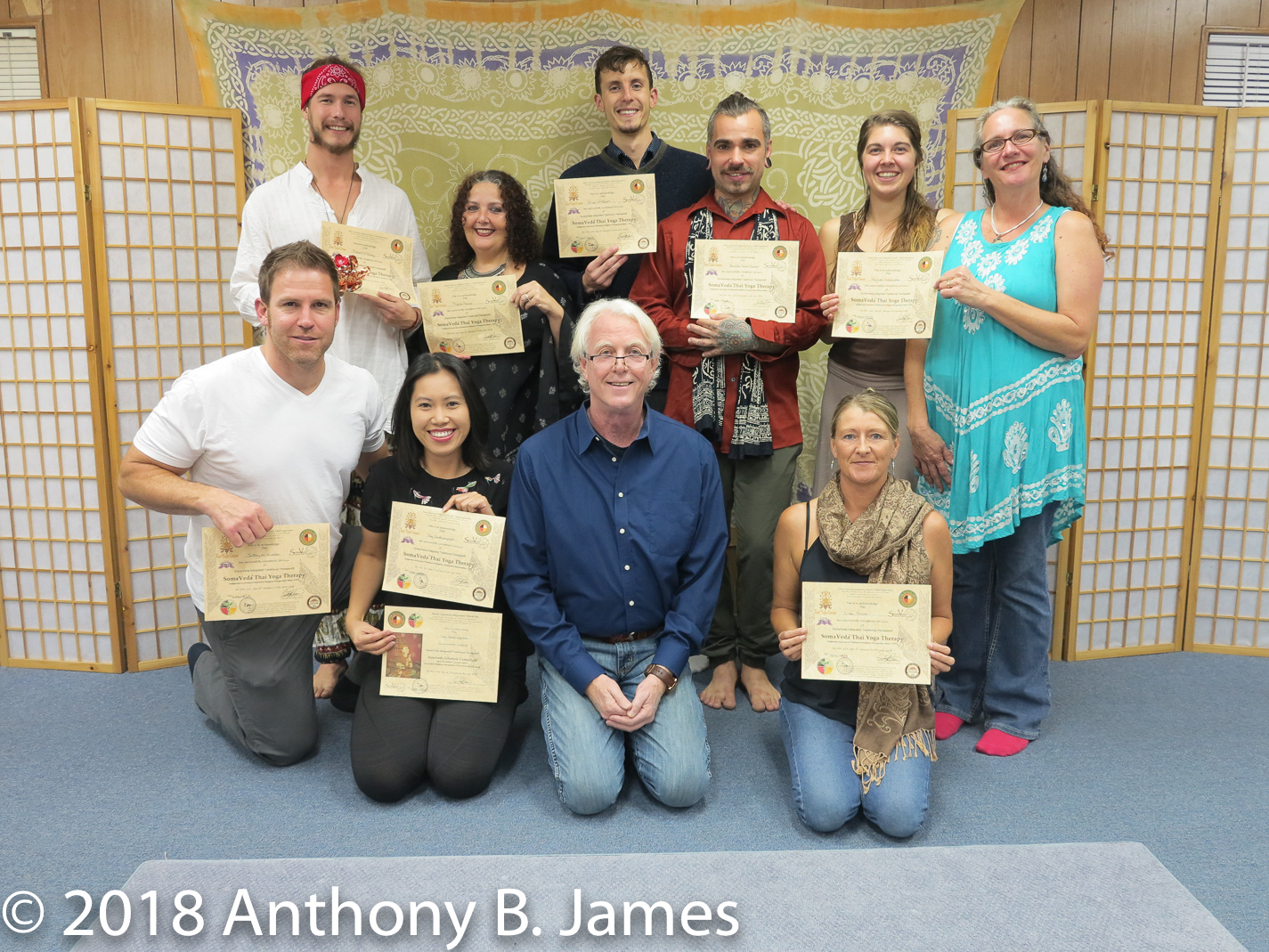
Brooksville, FL – January 2018 – Exceptional SomaVeda® Teachers, students and Practitioners from around the country and with varying levels of previous experience completed the 200 hour SomaVeda® Indigenous Thai Yoga Practitioner Certificate program. The Traditional Thai Yoga Practitioner programs are conducted under the authority of NAIC/ SCNM: Thai Yoga Center.
Each one individually and as part of an amazing group completed the requirements necessary to graduate with the prestigious Thai Yoga Center Certified SomaVeda® Thai Yoga Practitioner and or Teacher certificate.
No other College of Natural Medicine, Registered School of Ayurveda and or Traditional Thai Yoga (Traditional Thai Massage) School offers this comprehensive curriculum.
Beginner and Intermediate students completed all required course work including additional personal intensive training and coaching with Aachan, Dr. Anthony B. James according to their individual practice. This individual coaching centered on spiritual and personal issues as well as both personal and professional ministry development. Every student learns how to develop a successful ministry model and therapeutic practice.
Each student was personally taught and coached individually by Aachan, Dr. Anthony B. James, Master teacher of SomaVeda® Thai Yoga supported by SomaVeda® Certified Teachers Dr. Julie James, and Khruu Dr. Arianna Coe. They now join the many other practitioners and teachers who have come out of SCNM: SomaVeda Integrated Traditional Therapies®: Thai Yoga Therapy and Indigenous Medicine courses.
We had four different classes ongoing! CTP1, AWC-ALC!
To see the Photo’s from the January 2018 CTP Certificate Program CLICK HERE!
SomaVeda Integrated Traditional Therapies® Annual Awards for Excellence in Practice, Promotion and Teaching of SomaVeda® Thai Yoga, Ayurveda and Indigenous Traditional Natural Medicine.
The prestigious awards were handed out by Aachan, Dr. Anthony B. James during the January 2018 SomaVeda® Thai Yoga Practitioner Certificate program in Brooksville, FL on January 23rd. 2018.
“Shivago Award” to Dr. Ariana Coe, Knoxville, TN Founder of Humiovi Thai Yoga Institute:
“SomaVeda® “Teacher of the Year 2017” to Dr. Maureen Hughes, St. Louis, MO founder and lead Teacher at Total Harmony:
“SomaVeda® International Presenter of the Year 2017” to Khruu Alex Ryberg, Cincinnatti, OH.
Congratulations to these fine teachers and promoters of the SomaVeda Integrated Traditional Therapies@ And SomaVeda® Thai Yoga, Ayurveda and Indigenous Traditional Natural Medicine system and certification Programs!
To learn more about SomaVeda® Thai Yoga Professional Ministerial Certification programs visit ThaiYogaCenter.Com
Listen to SomaVeda® Thai Yoga students describe their training in their own words. This testimonial is from a graduate of the SomaVeda® Thai Yoga Practitioner Certificate program: November 2017. SomaVeda® Thai Yoga is an Ayurveda and Yoga Therapy system based on the Ayurveda of Thailand. We have been offering this training full time since 1984! Visit us on the web at www.ThaiYogaCenter.Com. Please Like, Share and Comment!
What Is Traditional Thai Yoga or Traditional Thai Massage (Thai Yoga Massage)?
Thai Yoga is comprehensive, sophisticated healing arts derivative of Theraveda Buddhism, Buddhist medicine, Buddhist Psychology, Theraveda Vipassana Bhavana, Classical Indian and Tibetan Ayurveda and Yoga Vedanta. It is not required that one become a Buddhist to practice this healing art, though it is helpful to understand Buddhist principles. It is more accurate to call this medicine by its traditional names like “ancient, anachronistic or Old Thai Way of Healing with The Hands,” but the slang form, “Thai Massage” is in use, and as long as this is so there will be some understandable confusion.
The type of traditional Thai Yoga therapy that most people will be exposed to is ráksãa thaang nûat (healing massage treatment). This is commonly known as the Nuat Thai or Nuad Boran styles of Thai Yoga therapy, spiritual massage, and healing work of Thailand.
The primary outcomes associated with the practice of Thai Yoga are called ProMiiWihan Sii ( Brahmavihara) or four divine, boundless sublime states of mind; Love, Compassion, Joy and Equanimity. As long as these four qualities are communicated, transmitted and exemplified during a session, it is considered to be successful. For this reason it is possible to have a Thai Yoga session with little or no actual touching!
In addition to the four divine states of mind we practice and perform Puja– a ritual healing process of prayer, affirmation and acknowledgement. We acknowledge the sacred space shared by client and Yogi, we honor and acknowledge the Bodhisattvas and progenitors of our way and teaching, and we “generate the Boddichitta,” the perfected mental processes of enlightened beings through Mantra recitation of OmNamoShivago, the Metta Sutra or anything else that invokes and invites the essence and energy of love and healing to move within ourselves and our client.
This prayerful and thoughtful meditation attunes powerful energies and petitions the sacred and symbolic metaphors of deities, ancient guides, and role models that provide the basis for all further communication and expression of Promiiwihan Sii.
The secondary outcomes are of lesser importance and may or may not share characteristics common to many forms of western massage such as effleurage (stroking and kneading the muscles), manipulation (manipulating or aligning osseous or skeletal parts) and pressure point or acupressure style technique (applying deep, consistent pressure to specific nerves, tendons, or ligaments and accupoints or Lom). In order to balance the functions of the four Dosha or body elements called thâat tháng sìi (Lom, Fai, Din, Naam), Thai Yoga incorporates elements of energetic and Prana assessment, mindfulness, gentle rocking, Asana positional release, deep stretching, focused breathing or Prana Yama, Chakra balancing, Prana Nadi or Sen line balancing and rhythmic compression to create a singular healing experience.
Native American Indigenous Church (NAIC),The SomaVeda College of Natural Medicine (SCNM) and the Thai Yoga Center are representative of and support authentic Traditional Thai Medicine (TTM), Thai culture and healing arts. Our member instructors are directly authorized teachers, representatives and traditional lineage holders in several different traditional secular and Buddhist schools:
–Buddhai Sawan Institute Ayudthaya and Nongkam (famous for martial and healing arts for 900 years)
–Phra Wat Chetuphon (Buddhist Temple, Wat Po Traditional Thai Medical School…One of the oldest schools of traditional arts),
–Buntautuk Hilltribes Northern Provencial Hospital and Training Institute also known as “The Old Medicine Hospital of Shivago Komarpai.”
-ITM (International Thai Massage, Chiangmai)
–Mama Lek Chaiya
-The Foundation for the Blind
-Buddhist Temple Wat Sawankholok, School for the Blind
–Wiang Klaikangwon Industrial Community & Educational College program sponsored by HM. King Bhumibol, Anantasuk Thai Massage)
There are several other significant lineages, teachers and Grand Masters. Most important is the Buddhist medicine derived from the famous Saint Shivago (Jivaka). In the United States traditional lineage and teaching is primarily passed on via the educational programs of the Thai Yoga Center in Brooksville, FL. Additionally, we recognize all schools formally recognized by the Royal Thai Ministries of Health and of Education and The Union of Thai Traditional Medicine Society (UTTS) listed or not!
There are actually quite a few different traditional “schools” of Thai yoga Therapy. They range from the big university driven or supported programs of Bangkok, to the “family” style oral and traditional lineages of Thailand’s Northern Hill Tribe people such as Karen, Lisu, Lahu, Mien and Akha People. Their influence is a growing factor in the modern expression of Thai Massage, especially in the North.
Thai Yoga is a colloquial or geographically distinctive system. Modern Thai yoga Therapy is a synthesis of several different regional variations based on location, region and in some cases the specific influence of a charismatic teacher. Traditionally there was mention of the “Seven Schools”. Of course there was not in the past only seven schools! Considering this was the primary medicine of millions of people for over a thousand years it is logical to assume there were many different schools in operation at one time or another. For example, every temple teaching or practicing these healing arts could have been considered a school and there were hundreds if not thousands of these over the years.
The most famous traditional school in the north is The Buntautuk Northern Hill Tribe Medical Hospital or “The Old Medicine Hospital.” Under the auspices of Grand Master Aajan Sintorn Chaichagun (Transitioned November 2005) it has become a national and international phenomenon. Teaching various levels of programs to Thai and falang (foreigner) alike, Aajan Sintorn was also famous for his daily recitation of the Pali Om Namo Shivago prayer and invocation for blessing. Twice each day he would lead the entire community in this rhythmic and beautiful traditional mantra for healing. In the north they say, “you don’t know Thai Massage until you know this mantra!” Today the Wat Po Association of Traditional Doctors, member schools and Aachans or Master Instructors are bringing this work into the modern world. Famous schools and their head Masters such as Anantasuk Rongrian under both Phaa Kruu Anantasuk and Aachan Nantipa Anantasuk work with the King’s Rajaprajanugroh projects to completely document the traditional medicine and preserve its rich heritage.
Northern Thailand is closer to main land China so there is more Chinese and Laotion influenced massage techniques. For example, a well known teacher and practitioner in Chiangmai, Mama Lek Chaiya and her family teach what is called nûat jàp sên (nerve-touch massage), a Chinese-style massage technique that works with the body’s nerve meridians much like acupuncture. Some of the plucking techniques are reminiscent of Tuina and can be quite unpleasant. However, the ultimate aim of balancing the chi takes precedence over comfort!
It is important to remember that any and all applications of physical pressure are intended to convey ProMiiwihan Sii to balance and harmonize the thâat tháng sìi and Tri_dosha or Three Winds, Humors or energetically based body types. Thai yoga is a sophisticated system of exchanging love with pressure, just as a hug can convey care, consideration and love with physical pressure. It’s just that in Thai Yoga that loving embrace is conveyed with great detail and sophistication.
The practice of Thai Yoga is substantially based on principles of classical Ayurveda as described in the Caraka Samhita Sutra, Susrita Samhita Sutra, Gheranda Samhita, Atharvaveda, Pradipika, and Ramayana, without most of the overt references to Hindu deities. The philosophies and principles of these Ayurvedic texts have also been re-interpreted in Theraveda Buddhism. Two influential texts in the Theraveda system are the Buddha Dhama and the Vipassana Bhavanna. Ayurvedic practices emphasized in Thai yoga include Samkhya (Sanskrit= Satkhya), Creation Cosmology, Rajas, Satvas and Tamas, Dhatus, Doshas, Sen Lines (Prana Nadi), Lom (Wind Gates, Sanskrit= Marma), Pancha Karma, Asana, Prana Yama, and Mantra.
Traditional Thai Yoga IS Yoga and has within it’s practice all of the benefits of Yoga practice. To read an outstanding article on 18 amazing benifits of Yoga, According to Science by Author Jen Miller Click Here!
The four Thai Ayurvedic elements are: earth (din-solid parts of the body, including nerves, skeleton, muscles, blood vessels, tendons and ligaments); water (náam-blood and bodily secretions); fire (fai-digestion and metabolism); and air (lom-respiration, and circulation). Borrowing from India’s Ayurvedic tradition, some practitioners employ Pali-Sanskrit terms for the four bodily elements: pathavidhatu, apodhatu, tecodhatu and vayodhatu. The book “Lines, Wheels, Points and Specific Remedies” covers this theory in detail.
Thai Yoga Massage and or Traditional Thai massage are systems of yoga therapy and all aspects Somaveda® Style Thai Yoga follow Ayurvedic and yogic principles.
From the Ayudthaya period until early this century, the Thai government’s Department of Health included an official massage (Marma Cikitsa) division (phanâek mãw nûat). Under the influence of international medicine and modern hospital development, the responsibility for the national propagation/maintenance of temple based Thai Ayurveda was eventually transferred to Phra Wat Chetaphon (Wat Pho) in Bangkok, where it remains today. Traditional Yoga therapy has persisted in most of the provinces and there has recently been a resurgence of popularity throughout the country. The Wat Po system is divided into two completely separate and distinctive categories: the tourist massage pavilion and Tourist massage school, (Ronrian Sala Thaang Nuaat) and the School for traditional Medicine for training and certification of Maw Nuad (Massage Doctors). There are huge differences in the term and quality of training. For example, a tourist may receive an introductory massage certificate in as little as ten days, where the full program for Maw Nuad is twelve to fourteen semesters or four full years. In the United States we have many different levels of recognitions for Certified Thai Yoga/Massage Practitioners.
The Royal Thai Ministry of Health relies on the Union of Thai Traditional Medicine Society (UTTS) to formulate and maintain standards of practice and competency necessary for formal licensing of secular, non-religious professional Traditional Thai Medicine providers in the kingdom.
Within the traditional Thai medical context, a Thai Yoga massage therapist (mãw nûat, literally, ‘massage doctor’) usually applies Thai Yoga together with pharmacological (herbal) and/or psycho-spiritual treatments as prescribed for a specific problem or specific imbalance of the Dosha or winds and humors of the body, mind, and spirit. It is becoming quite popular for many Thais to also use traditional Thai Yoga as a tool for relaxation and disease prevention, rather than for a specific medical problem. However, once you leave the big city and move into the country you begin to see more reliance on the application as energy based medicine. This includes the resurgence and growing popularity of the self treatment regimes and Yoga practices of “Reusi Dotan” or Reishi Yoga.
Traditional Thai yoga, Thai Yoga massage and or Thai massage is not the same as “Massage,” “Massage Therapy,” or “bodywork,” as commonly defined in so-called “Massage Laws.” The term “Thai Massage” is western slang, mostly promoted by tourists in Thailand. Although the use of the term is now common, it still is misunderstood and misused by the misinformed. It is easy to be confused when similar words are used, such as “Massage,” but legally there are distinctions and differences in definitions.
Please note: In common English when we use the word “massage” we do not mean it in the same context as the typical western usage. In the west “Massage” means something like a “rub down” for money and is primarily referring to systems derived from Swedish Massage and Massage Therapy. “Thai Yoga and or Thai Massage” (Phaen Boran Ráksãa Thaang Nûat) is completely unrelated!
Legally words can have different meanings than words used in common, non-legal language. For example, “Massage and Massage Therapy” definitions are based on the practice of “Swedish massage.” “Swedish Massage” is new (less than one hundred years) in European and American culture. According to the National Center for Complementary and Alternative Medicine “The term “massage therapy” encompasses many different techniques (see box for examples). In general, therapists press, rub, and otherwise manipulate the muscles and other soft tissues of the body. They most often use their hands and fingers, but may use their forearms, elbows, or feet”.
Compare this definition with the definition given for what is Thai Yoga at the beginning of this article “Thai Yoga is comprehensive, sophisticated healing arts derivative of Theraveda Buddhism, Buddhist medicine, Buddhist Psychology, Theraveda Vipassana Bhavana, Classical Indian and Tibetan Ayurveda and Yoga Vedanta. “
Thai yoga massage sounds similar to Western-style massage at first glance, but what is not mentioned in the proceeding definition is that Thai yoga massage is a spiritually based system of healing and movement education (Yoga). It is based entirely on principles of energy balancing (Sen, Tri-Dosha, Lom, Chakra etc.) and the actual touching, contact or soft tissue manipulation is incidental to, and not the central aim of the practice! I want to emphasize this statement again “It is possible to have a Thai Yoga session with little or no actual touching”. However, touching is good! This work brings fundamental elements and energy into harmony and creates wholeness of mind, body and spirit.
Thai yoga massage is a spiritually based Somatic technique and profession, a modality with standards established in the Buddhist holistic centers and temples thousands of years ago. It has an established code of ethics known as the Buddha Dharma, The Eight Fold Path, Ahimsa (non-violence) and the “Ten Rules of the Healer.” There is an established criterion for education and professional practice for services that were never intended to be “Massage” or “Massage therapy.”
Where Can I Learn Thai Yoga and Thai Massage?
1) NAIC/ SCNM: Thai Yoga Center provides a registry of approved schools, teachers and certified practitioners of Thai Yoga and Thai Massage. Thai Yoga and Thai Massage Directory
NAIC Members are legally entitled to practice Thai yoga, Thai Yoga Therapy , Thai Massage in all fifty states with NAIC Membership and Authorization without requiring any special licensing. Of course that means as long as what is practiced is not in violation of existing medical laws or that the practice is under the umbrella of an expressive private membership association or recognized church or ecclesiastical authority or organization. We are happy to answer any questions that you have pertaining to the legal practice of our energetic and spiritually based art of healing and transformation.
2)The Thai Yoga Center: In the US today the traditional lineages of Thai Yoga Therapy and Traditional Thai Massage are passed on via the in Brooksville, Florida through the Mastery and teaching of Aachan Anthony B. James ND, MDAM. Aachan James, after 30 plus years of extensive devotion, practice and research brings several different and complimentary traditional lineages to life.
To learn more about the SomaVeda College of Natural Medicine and Thai Yoga Center Click Here!
SomaVeda® Thai Yoga is the core modality of our four Certificate and five College Degree Programs. Other elements include but are not limited to Ayurveda, Traditional Chinese Medicine, Native American and Western Nature Cure or Traditional Naturopathy (Non-Drug, Non-Surgery, Non-Radiation or any dangerous, unsafe, invasive, non-natural therapy).
The SomaVeda® Thai Yoga based Associate of Sacred Arts: Major Natural Wellness(SCNM: A.S.A) degree program qualifies graduates to sit for the ANMCB (American Naturopathic Medical Certification Board) Traditional Naturopathic National Boards. A Traditional Naturopath is considered by many to be at the top of the holistic pyramid. We have established a program to educate conscience and spirit based natural and holistic health providers and ministers of all types and levels in the traditional, spiritual based healing methods of Thai Yoga.
If this all sounds interesting to you and you would like to experience SomaVeda@ Thai Yoga on a first hand basis, then consider taking one of our certification courses or joining one of our famous Thailand Externship Programs. We have been providing quality access to Thailand, Thai yoga massage and Thai Culture for over 30 years. Our programs feature extensive hands on massage training and internationally recognized certification as well as great exposure to the country and the people through our Eco-Tour, country survey style approach. Join us for the adventure of a lifetime!
For more information on educational materials by this author see the Yoga Therapy bookstore at BeardedMedia.Com. If you think your friends would benefit from this information please have them subscribe to our newsletter!
Disclaimer: All Information is provided for educational purposes only and not intended to be used for any therapeutic purpose, neither is it intended to diagnose, prevent, treat or cure any disease. Please consult a health care professional for diagnosis and treatment of medical conditions. No infection treatment products are sold from this website and every attempt is made to make statements which are unbiased and are solely in the best interest of the members, public and patient.While all attempts have been made to ensure the accuracy of this information. The author and ThaiYogaCenter.Com does not accept any responsibility for any errors or omissions.
The information provided in this article and or website has not been reviewed by the FDA. The FDA specifically considers anecdotal information and or research to be unreliable and or non valid. Additionally the information provided in this article is educational and to some degree anecdotal and in no context or meaning is it implied by the author or the website that it be intended as a substitute for competent medical advise. Patients suffering from a severe medical condition are advised to consult with their physician.
The SCNM: Thai Yoga Center Announces Indigenous Thai Yoga Practitioner Program Graduating Thai Yoga Class at NAIC Sanctuary: November 2017
Brooksville, FL – November 2017 – Exceptional SomaVeda® Teachers, students and Practitioners from around the country and with varying levels of previous experience completed the November 2017: 200 hour SomaVeda® Indigenous Thai Yoga Practitioner Certificate program. The Traditional Thai Yoga Practitioner programs are conducted under the authority of NAIC/ SCNM: Thai Yoga Center.
Each one individually and as part of an amazing group completed the requirements necessary to graduate with the prestigious Thai Yoga Center Certified SomaVeda® Thai Yoga Practitioner and or Teacher certificate.
No other College of Natural Medicine, Registered School of Ayurveda and or Traditional Thai Yoga (Traditional Thai Massage) School offers this comprehensive curriculum.
Beginner and Intermediate students completed all required course work including additional personal intensive training and coaching with Aachan, Dr. Anthony B. James according to their individual practice. This individual coaching centered on spiritual and personal issues as well as both personal and professional ministry development. Every student learns how to develop a successful ministry model and therapeutic practice.
Each student was personally taught and coached individually by Aachan, Dr. Anthony B. James, Master teacher of SomaVeda® Thai Yoga supported by SomaVeda® Certified Teachers Dr. Julie James, and Khruu Maureen Hughes CTT, Khruu Rachael Marshall CTT, Khruu Suzy Corgiat CTT, Khruu Marianna Cardoza CTT. They now join the many other practitioners and teachers who have come out of SCNM: SomaVeda Integrated Traditional Therapies®: Thai Yoga Therapy and Indigenous Medicine courses.
We had four different classes ongoing! CTP1, AWC, AHC and TCP!
To see the Photo’s from the June 2017 CTP Certificate Program CLICK HERE!
Marianna Cardoza completed her SomaVeda® Thai Yoga Teacher Certification Program! Congratz Khruu Marianna and welcome to SCNM/ Thai Yoga Center Adjunct faculty.
November 2017, Mariana Cardoza receives SomaVeda® Teacher Certification from Aachan, Dr. Anthony B. James
Special Program! Visit Exotic THAILAND April 2018!
April 10th. to April 28th. 2018
This is 19 day excursion. (Receive NAIC/ SomaVeda®, NCBTMB and recognized CE hours and hands on training in Classical Indigenous Thai Yoga, Thai Massage Certificate in one inclusive training!).
Included for your experience amazing temples, instruction from awesome teachers and Masters, street fairs and markets, food like you’ve never had, Buddhist monks & nuns, music and night life after class. Tours in the beautiful Thai upcountry, hill tribe people and classical dancing, road trips across country, Golden Triangle, Chiangrai, Bangkok and Thai city life, River boats and the Summer palace, the famous Bangkok shrines and temples with a side trip to the largest outdoor market in Thailand- Chatuchak, Koh Samuii Island paradise and the quaint town of Lamaii, Yoga, meditation, energy healing, classes and fun with like minded souls.
Have a look at actual photo’s from actual past programs! Click Here!
Video’s from past trips!
This is our 38th. annual Thailand excursion. We know how to get around and get the most for your investment. Our experienced guides and facilitators are simply the best available and our dedication is proven over time. Let us show you the hidden, the amazing, the unseen the miraculous, the special, the sacred and the fun of traveling and training in Thailand this next April 2018!
NAICS Inc., Aachan and Diplomat, Aachan, Professor Dr. Anthony B. James, DNM(P), ND, MD(AM), DPHC(h.c.), Ph.D., RAAC, SMOKH and our local Thai providers and Master teachers provide Indigenous Traditional Thai Art & Religious Therapeutics Practicum In Thailand, April 2018. This program will provide you with over two weeks (19 days including travel days) in Thailand. You’ll get the exciting opportunity to visit Bangkok, Chiang Mai, Pang Lang, Chiang Rai, Mae Sai and Koh Samuii Island, Thailand areas.
As usual, we will be basing our program on a Cultural Immersion / Eco-Tour type of approach. We spend a significant portion of our program time working with indigenous teachers and professional Thai staff (UTTS Ministry Authorized), in actually experiencing and learning traditional Thai Yoga and Ayurveda healing arts and culture. This year we are focusing on Indigenous Thai Traditional Medicine (TTM) and Herbology.
We have the experience and commitment to having your experience in the kingdom of Thailand to be the very best.
This amazing program, NON- AIR, is available for $1,995.00!